2026 Best Industrial RFID Tablets for Global Buyers
Choosing the right INDUSTRIAL RFID TABLETS can shape daily productivity, inventory accuracy, and worker safety. Global buyers need more than attractive specifications. They need equipment that performs beside loading docks, warehouse racks, production lines, and outdoor storage yards.
This guide examines leading 2026 models through practical purchasing criteria. These include RFID read distance, scan consistency, processor performance, battery endurance, screen visibility, glove operation, durability, and connectivity. A tablet may promise strong performance, yet real conditions can expose weaknesses. Cold batteries drain faster. Metal surfaces can affect RFID signals. Wet gloves can make small buttons frustrating.
Details matter.
Reliable selection also requires checking operating-system support, repair access, warranty terms, regional certifications, and software compatibility. Buyers should confirm test results with suppliers and request realistic demonstrations before placing large orders. Independent reviews are useful, but they cannot replace an on-site trial. That limitation deserves honesty.
The strongest devices balance rugged construction with practical usability. A heavy tablet may survive drops but tire workers during long shifts. A powerful RFID reader may still underperform when tags are poorly placed or densely grouped. This guide compares those trade-offs for distributors, manufacturers, logistics teams, retailers, and service providers across international markets.
Product availability, wireless bands, and support policies can vary by country. Verify current documentation before purchase. A careful decision may cost more initially, but it can reduce scanning delays, replacement expenses, and workflow disruption. These are not glamorous benefits. They are the ones operators notice every day.
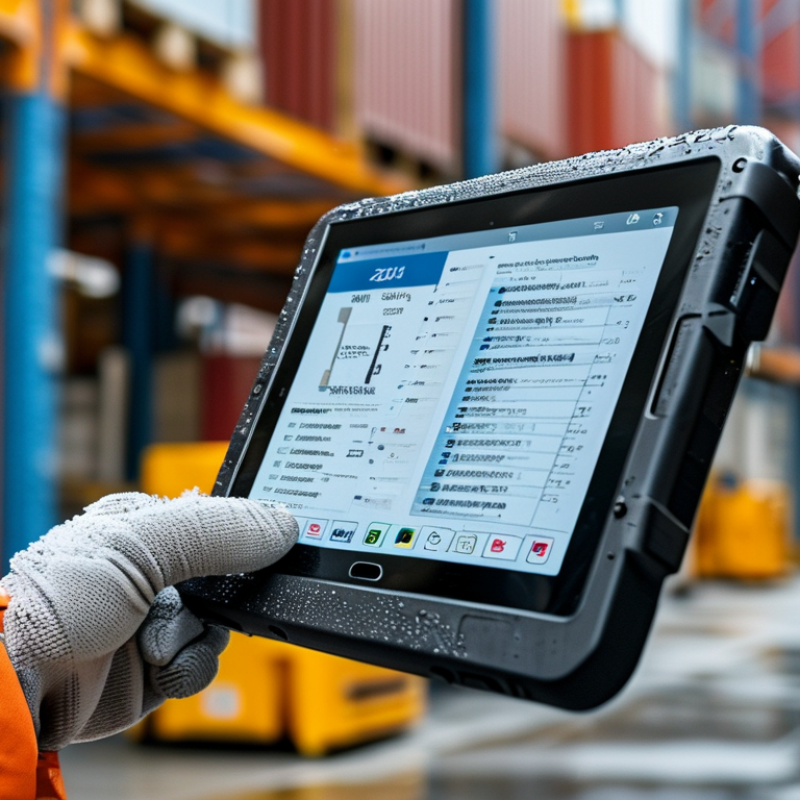
RFID Tablet Basics: HF 13.56 MHz Versus UHF 860–960 MHz
For global buyers comparing industrial RFID tablets in 2026, frequency choice matters more than screen size. HF RFID at 13.56 MHz usually reads a nearby tag, often within a few centimeters or roughly one meter. It suits access cards, item confirmation, tool tracking, and patient wristbands. The short read zone reduces accidental scans. That control helps beside crowded workbenches. Yet wet materials and metals can weaken performance, so laboratory results may disappoint on a factory floor.
UHF RFID operates across 860–960 MHz, with regional allocations requiring careful validation. It can identify many tagged items from several meters away. This suits pallet checks, yard inventory, and dock-door workflows. A worker may scan a loaded cart without touching each box.
Fast, but not magical. Liquids, foil packaging, stacked products, and metal racks can create dead zones or unwanted reads. Antenna placement, tag orientation, reader power, and software filtering need field testing.
A dependable industrial tablet should remain stable with gloves, dust, vibration, and bright outdoor light. Check battery endurance during a full shift, IP protection, drop resistance, offline storage, and secure synchronization.
HF often works better for deliberate, close-range confirmation. UHF is stronger for volume and distance. The boundary is not absolute. I have seen a carefully positioned HF setup outperform a poorly tuned UHF installation. That result is easy to overlook. Test real tags, liquids, metal surfaces, and operator movements before approving a global rollout.
Read Performance: 1–15 m UHF Range and 200+ Tags per Second
In 2026, global buyers are looking beyond screen size when evaluating industrial RFID tablets. The critical question is simple: can the reader capture tags quickly, accurately, and at a useful distance? A practical UHF range of 1–15 meters supports workflows from shelf scanning to pallet verification. Distance is not a fixed promise. Metal racks, liquid products, antenna angle, and warehouse traffic can reduce performance. Experienced operators test the tablet in the real aisle, not only in a quiet showroom. That detail matters.
A reader processing more than 200 tags per second can shorten cycle counts and reduce repeated scans. It is useful when workers pass dense cases or scan a loaded staging area. Still, speed needs context. A high tag rate means little if missed reads require manual rechecking. Buyers should measure read accuracy, duplicate filtering, trigger response, and battery use during continuous scanning. A stable grip, bright display, physical buttons, and glove-friendly controls also affect output. Small ergonomic failures become expensive across thousands of scans.
Reliable procurement includes documented test conditions, firmware support, repair options, and training resources. Ask for results with your tag types, packaging, and reader settings. Do not rely on peak figures alone. In field trials, I would record reads at 1, 5, 10, and 15 meters, then repeat testing near metal and liquids. The honest result may be lower than the specification. That is not a defect by itself. It shows where the tablet needs process limits or better antenna positioning.
2026 Best Industrial RFID Tablets for Global Buyers - Read Performance: 1–15 m UHF Range and 200+ Tags per Second
Representative industrial configuration comparison for warehouse, logistics, manufacturing, retail and field-inventory applications
| Tablet Configuration | Recommended Use | UHF RFID Read Range | Read Performance | Supported RFID Band | Operating System | Memory / Storage | Ingress Protection | Drop Resistance | Battery Capacity | Operating Temperature | Connectivity |
| Compact Warehouse Tablet | Bin checks, receiving desks and cycle counting | 1–8 m | 200–260 tags/s | UHF EPC Class 1 Gen 2 / ISO 18000-63 | Android 13 or later | 4 GB RAM / 64 GB flash | IP65 | 1.2 m on concrete | 5,000 mAh | −10°C to 50°C | Wi-Fi 5, Bluetooth 5.x, USB-C, optional 4G |
| Standard Logistics Tablet | Warehouse aisles, parcel handling and pallet identification | 1–10 m | 250–350 tags/s | UHF EPC Class 1 Gen 2 / ISO 18000-63 | Android 13 or later | 6 GB RAM / 128 GB flash | IP65 | 1.5 m on concrete | 6,000 mAh | −20°C to 55°C | Wi-Fi 6, Bluetooth 5.x, USB-C, 4G LTE |
| Heavy-Duty Industrial Tablet | Manufacturing plants, outdoor yards and asset tracking | 1–12 m | 300–450 tags/s | UHF EPC Class 1 Gen 2 / ISO 18000-63 | Android 14 or later | 8 GB RAM / 128 GB flash | IP67 | 1.8 m on concrete | 8,000 mAh | −20°C to 60°C | Wi-Fi 6, Bluetooth 5.x, USB-C, 4G/5G |
| Extended-Range UHF Tablet | Large warehouses, vehicle yards and dock-door scanning | 2–15 m | 350–600 tags/s | UHF EPC Class 1 Gen 2 / ISO 18000-63 | Android 14 or later | 8 GB RAM / 256 GB flash | IP67 | 1.8 m on concrete | 10,000 mAh | −20°C to 55°C | Wi-Fi 6E, Bluetooth 5.x, USB-C, 5G |
| Cold-Chain Rugged Tablet | Cold storage, food distribution and pharmaceutical logistics | 1–10 m | 200–320 tags/s | UHF EPC Class 1 Gen 2 / ISO 18000-63 | Android 13 or later | 6 GB RAM / 128 GB flash | IP67 | 1.5 m on concrete | 7,000 mAh | −30°C to 50°C | Wi-Fi 5/6, Bluetooth 5.x, USB-C, optional 4G |
| Vehicle-Mounted Inventory Tablet | Forklift operations, cross-docking and high-volume pallet movement | 2–12 m | 300–500 tags/s | UHF EPC Class 1 Gen 2 / ISO 18000-63 | Android 14 or later | 8 GB RAM / 128 GB flash | IP66 | 1.5 m on concrete | 8,000 mAh or vehicle power | −20°C to 55°C | Wi-Fi 6, Bluetooth 5.x, USB-C, 4G/5G, GNSS |
Performance note: UHF read distance and tag-throughput figures are representative operating ranges. Actual results depend on tag size and orientation, reader antenna configuration, regional transmission limits, reader-to-tag interference, materials, mounting height and the surrounding RF environment.
Rugged Design Standards: IP65/IP67, MIL-STD-810H, and 10,000 mAh
2026 Best Industrial RFID Tablets for Global Buyers
Industrial RFID tablets face dust, splash, drops, and long shifts. IP65 protects against dust and water jets. IP67 adds temporary immersion protection, usually up to one meter for 30 minutes. These ratings describe controlled laboratory conditions. Real sites are less predictable. Mud, detergent, and damaged port covers can weaken protection.
MIL-STD-810H indicates testing against selected environmental stresses, such as vibration, shock, temperature, and humidity. It is not a universal guarantee of ruggedness. Buyers should review the exact test methods and procedures. A tablet surviving a drop is valuable. A readable screen after repeated drops is better. In warehouse trials, sealed edges and reinforced corners often matter more than impressive marketing language.
Tips: Check the complete IP test report, not only the label. Confirm whether the RFID module works through gloves, plastic bins, and metal shelving. A 10,000 mAh battery can support extended scanning, but runtime depends on screen brightness, RFID power, wireless connections, and temperature. Carrying a spare battery may be wiser than trusting one large cell. Also inspect charging time and connector durability. I have seen strong devices lose productivity because charging docks were poorly positioned. The specification may look perfect, yet field handling still exposes weak points.
Global Compliance: FCC, CE, RoHS, 4G Bands, and Android 14 Support
Industrial RFID tablets for global buyers must be checked beyond scan distance and screen brightness. FCC approval supports radio use in the United States, while CE marking addresses applicable European requirements. RoHS focuses on restricted substances in electrical equipment. These marks are not interchangeable. Ask for current declarations, test reports, and product labels before placing a large order. Documents should match the exact model, radio module, battery, and charger.
Tips: Confirm the tablet’s supported 4G bands against each target carrier, not just the country name. Band coverage can vary between urban and rural networks. Request Android 14 security-update information, device-management compatibility, and the planned support period. Test RFID reads beside metal shelves, liquid containers, and moving forklifts. Real warehouses are less forgiving than a clean showroom.
A reliable evaluation also checks language settings, charging temperature, ingress protection, drop testing, and replacement-part access. I have seen projects slow down because a “global” tablet lacked one regional LTE band. That small detail mattered. Android 14 may improve control and security, but software support still depends on the supplier’s maintenance process. Verify update delivery, privacy controls, boot settings, and diagnostic logs. Keep a sample unit in field testing for several weeks. Paper compliance helps, but it cannot reveal every operational weakness.
2026 Buyer Matrix: Cost, TCO, Scan Accuracy, and Five-Year Serviceability
A 2026 buyer matrix should measure more than the tablet’s purchase price. The RAIN Alliance reported 38.5 billion RAIN RFID chips shipped in 2023, showing stronger demand for reliable identification workflows. However, a low-cost tablet can become expensive when batteries, scanners, cradles, and repairs require early replacement. Buyers should compare five-year TCO, including software updates, training, downtime, and spare-unit requirements.
Scan accuracy deserves controlled testing. GS1 guidance emphasizes tested tag placement, reader settings, and operating environments rather than headline read rates. In a warehouse, metal shelving, liquid containers, gloves, and forklift vibration can change results quickly. Record successful reads across repeated trials, then calculate accuracy by task. A 99% result in a clean test area may fall sharply on a busy loading dock.
Serviceability is less visible but often decisive. Specify replaceable batteries, sealed ports, accessible scan engines, repair turnaround, and documented security support. Industry rugged-device research commonly evaluates five-year lifecycle planning, but field conditions rarely match laboratory assumptions. Test one unit with real gloves and damaged labels. Keep the findings, even when they expose weaknesses. That evidence is more useful than a polished quotation.
2026 Best Industrial RFID Tablets for Global Buyers
2026 Buyer Matrix: Cost, TCO, Scan Accuracy, and Five-Year Serviceability
The comparison uses representative 2026 market benchmarks for industrial RFID tablet categories. Cost and five-year total cost of ownership are shown in USD, while scan accuracy and serviceability are percentage indicators based on typical UHF RFID performance, warranty coverage, replaceable components, repair access, and long-term software support.


