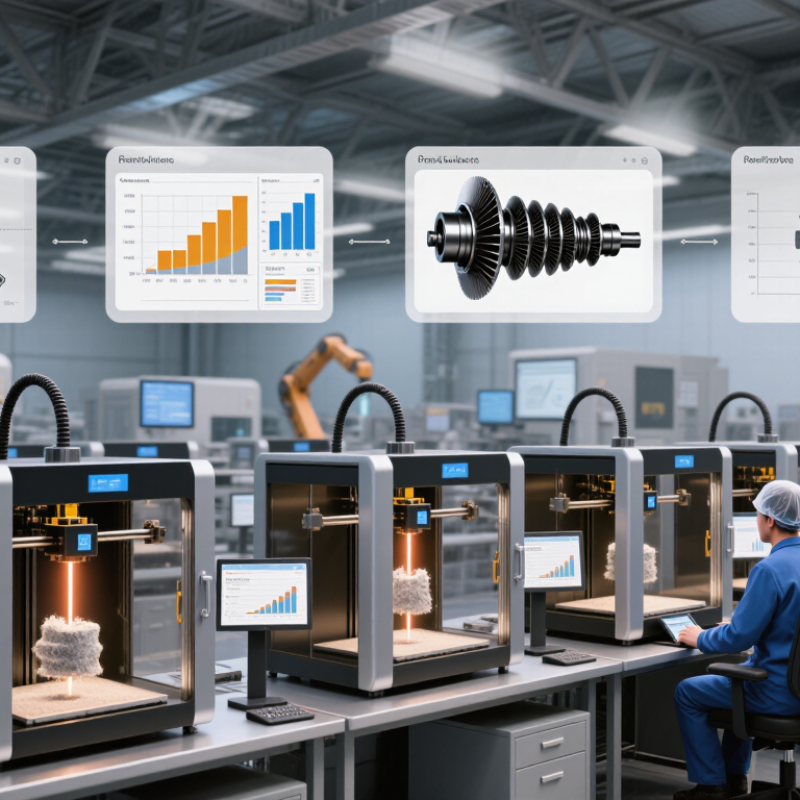
Choosing the top steel 3D printing manufacturers worldwide requires more than comparing glossy brochures. Real performance appears in the workshop, where a steel powder bed becomes a dense turbine component, tooling insert, or medical implant.
This guide examines manufacturers through practical evidence: machine stability, material compatibility, build volume, dimensional accuracy, software control, and post-processing support. It also considers whether suppliers can move from a successful prototype to repeatable production. That transition is often difficult. A beautiful sample part does not guarantee dependable industrial output.
Terry Wohlers, a widely cited additive manufacturing analyst, said, “The future of manufacturing is digital.” His observation remains relevant to steel 3D printing, where digital files, process monitoring, and automated inspection influence every layer. Leading companies are investing in laser powder bed fusion, directed energy deposition, and hybrid systems. However, no single process suits every factory.
Some manufacturers excel at aerospace-grade alloys. Others focus on large-format construction, energy equipment, or specialized tooling. Certification support may matter more than headline printing speed. Service networks matter, too. A delayed replacement optic can stop a production line for days.
This overview compares global manufacturers using technical capability, industrial experience, application depth, and customer reliability. It avoids treating market visibility as proof of superiority. Rankings can be imperfect. Data changes quickly. Independent testing still matters.
The strongest supplier is not always the largest one. It is the company that fits the part, material, budget, and production risk. That is where careful evaluation begins.
Steel 3D printing uses digital designs to produce metal parts layer by layer. It commonly relies on laser powder bed fusion, binder jetting, or directed energy deposition. These methods work with stainless steel, tool steel, and maraging steel. They can create internal channels, lattice structures, and complex shapes that conventional machining may struggle to produce. A 316L stainless-steel heat exchanger, for example, can contain narrow cooling paths inside one printed component. That design may reduce assembly work and improve thermal performance.
The Wohlers Report 2024 valued the global additive manufacturing industry at 20.035 billion dollars in 2023, representing 13.5% annual growth. This expansion reflects stronger demand for customized tooling, aerospace components, medical devices, and industrial repair. Manufacturers worldwide are therefore judged by more than printer size. Buyers should examine powder quality, process monitoring, build repeatability, certification support, and post-processing capacity. ASTM International standards also emphasize consistent terminology, testing, and qualification across additive manufacturing workflows. Important work remains.
Steel printing is not automatically cheaper or greener. Energy use, powder recovery, support removal, and heat treatment can change the final impact. Parts may also show residual stress or directional strength, especially when parameters are poorly controlled. The business case is sometimes overstated. Reliable suppliers combine production data with destructive testing, dimensional inspection, and experienced engineering review. As reported by the International Energy Agency, industrial energy efficiency remains essential for lowering manufacturing emissions, so process efficiency deserves equal attention alongside geometric freedom.
Steel 3D printing uses processes such as laser powder bed fusion, electron beam melting, and binder jetting to produce complex metal parts layer by layer. The chart compares the typical room-temperature density of widely used steel alloys in additive manufacturing. These material properties help engineers select alloys for strength, durability, corrosion resistance, and weight requirements.
Approximate density values are representative of commonly specified wrought and additive-manufacturing steel grades; actual values may vary slightly with composition, porosity, and processing conditions.
Evaluating steel 3D printing manufacturers worldwide requires more than comparing machine prices. Start with process capability, material control, and documented production experience. Ask which steel alloys they print regularly, not only which alloys they advertise. Request sample parts with measured tolerances, surface finish data, and density results. Ask for test coupons. Real evidence matters.
Review how each manufacturer manages powder storage, machine calibration, heat treatment, and inspection. Reliable suppliers can explain their traceability process from raw powder to finished component. Check whether they use dimensional scanning, hardness testing, and non-destructive inspection when appropriate. Certifications can support credibility, but they should not replace technical conversations. A certificate does not prove every part is consistent.
Capacity also deserves careful attention. A supplier may produce an excellent prototype yet struggle with repeated batches. Ask about production history, average lead times, maintenance planning, and backup equipment. Discuss design support before signing a contract. Experienced engineers may identify weak walls, trapped powder, or distortion risks early. Cost comparisons should include finishing, inspection, shipping, and possible redesigns. The lowest quotation can become expensive later. No evaluation method is perfect. I would still compare identical test geometries across several suppliers, because marketing language often hides important differences. Keep communication records, clarify acceptance criteria, and request a small paid trial before approving larger orders.
Steel 3D printing manufacturers differ sharply by region and expertise. Wohlers Report 2024 valued the global additive manufacturing industry at about $20 billion in 2023. Metal systems represented a substantial share, driven by aerospace, tooling, medical, and energy applications. European manufacturers often emphasize certified production, powder-bed fusion, and process traceability. Their facilities commonly document powder batches, chamber temperatures, and post-processing cycles.
North American producers tend to focus on large-format systems, contract manufacturing, and rapid industrial deployment. Asian manufacturers are expanding strongly in cost-efficient metal systems, production automation, and materials development. SmarTech Analysis has identified metal additive manufacturing as a multibillion-dollar market, with continued growth expected from production applications rather than prototypes alone.
That distinction matters.
Some suppliers excel at thin-wall complexity. Others handle dense steel tooling with conformal cooling channels. A factory floor tells the truth. Look for calibrated laser records, tensile-test results, density measurements, and independent certification under ISO/ASTM standards.
Marketing claims are not enough.
Not every “industrial” machine delivers stable results across an entire build plate. This remains a practical weakness. Buyers should compare real production data, including defect rates, build time, powder reuse, and heat-treatment distortion. Regional strength helps, but application expertise usually decides the final outcome.
Top Steel 3D Printing Manufacturers Worldwide?
Key Technologies, Materials, and Services Offered
Leading steel 3D printing manufacturers typically use laser powder bed fusion for detailed, complex components. The process builds parts layer by layer from fine metal powder. Directed energy deposition supports larger repairs and near-net-shape structures. Binder jetting can produce batches efficiently, although shrinkage control remains demanding.
Common materials include stainless steel, tool steel, maraging steel, and selected low-alloy grades. Each material needs controlled powder size, moisture levels, and thermal settings. Reliable suppliers provide material certificates, machine calibration records, and batch traceability. They may also offer heat treatment, hot isostatic pressing, machining, surface finishing, and dimensional inspection.
The best service teams begin with design-for-additive-manufacturing advice. They check wall thickness, support placement, cooling channels, and expected loading. Simulation can reveal distortion before printing starts. Useful services include prototype production, small-batch manufacturing, reverse engineering, and failure analysis. Independent tensile, hardness, and fatigue testing adds confidence. It matters.
No process is flawless. Published strength data can look impressive, yet real performance depends on orientation, porosity, and post-processing. Some manufacturers still provide limited long-term fatigue evidence. That gap deserves careful review. Experienced buyers should request sample reports, inspection methods, and clear acceptance criteria before approving production.
| Leading Supplier Segment | Core Steel 3D Printing Technology | Common Steel and Iron-Based Materials | Typical Technical Parameters | Typical Industrial Applications | Services Commonly Offered | Quality and Compliance Focus |
|---|---|---|---|---|---|---|
| Industrial Powder-Bed Fusion Manufacturers | Laser Powder Bed Fusion Electron Beam Powder Bed Fusion |
316L stainless steel; 17-4 PH stainless steel; maraging steel; tool steel; precipitation-hardening steels. |
Typical layer thickness: approximately 20–80 μm. Fine feature resolution and high geometric complexity. Build volumes vary by machine platform. |
Lightweight aerospace components, medical instruments, conformal-cooled tooling, energy parts, fluid manifolds, and custom production components. | Design-for-additive-manufacturing support, process parameter development, powder management, in-process monitoring, heat treatment, support removal, machining, and inspection. | Material traceability, powder reuse controls, dimensional inspection, density verification, heat-treatment records, and qualification against customer specifications. |
| Directed Energy Deposition Manufacturers | Laser DED Electron Beam DED Wire-Arc DED | Stainless steels, low-alloy steels, tool steels, nickel-free iron-based alloys, and repair-grade steel feedstocks supplied as powder or wire. |
Typical deposited layer height: approximately 0.25–1.5 mm for laser or electron-beam systems. Larger deposition rates than powder-bed systems. |
Repair of molds and dies, rebuilding worn shafts, large near-net-shape structures, cladding, feature addition, and hybrid manufacturing. | Component repair, surface enhancement, multi-axis deposition, in-situ machining, dimensional correction, cladding, and large-part production. | Deposition geometry control, metallurgical bonding, porosity assessment, hardness testing, nondestructive testing, and process qualification. |
| Wire-Arc Additive Manufacturing Specialists | WAAM Robotic Arc Deposition | Carbon steel, low-alloy steel, stainless steel, duplex stainless steel, and selected corrosion-resistant steel wire grades. |
Typical bead or layer height: approximately 1–3 mm. Deposition rates commonly range from about 1–10 kg per hour, depending on equipment and process settings. |
Large structural parts, marine components, pressure-equipment prototypes, tooling, construction elements, and heavy-equipment repairs. | Robotic path planning, large-format deposition, interpass temperature control, rough machining, final machining, and structural inspection. | Welding-procedure qualification, heat-input control, interpass-temperature records, ultrasonic testing, radiographic testing, and mechanical testing. |
| Metal Binder Jetting Manufacturers | Metal Binder Jetting Debinding and Sintering | 316L stainless steel, 17-4 PH stainless steel, carbon steel, tool steel, and other sinterable iron-based powders. |
Typical layer thickness: approximately 50–200 μm. High batch productivity with dimensional shrinkage during sintering. |
Medium-volume production, small industrial parts, brackets, housings, consumer hardware, and geometries that benefit from batch processing. | Powder preparation, printing, depowdering, debinding, sintering, shrinkage compensation, sizing, machining, and batch inspection. | Sintering-atmosphere control, density measurement, dimensional compensation, chemical analysis, and lot-based material traceability. |
| Large-Format Steel Additive Manufacturers | Large-Scale DED Hybrid Additive-Subtractive Manufacturing | Carbon steel, stainless steel, low-alloy steel, tool steel, and corrosion-resistant steel wire or powder feedstocks. |
Large build envelopes with comparatively coarse deposition tracks. Final accuracy is commonly achieved through subtractive machining. |
Molds, dies, large tooling, industrial base structures, shipbuilding components, heavy machinery, and replacement parts. | Large-part fabrication, near-net-shape deposition, CNC machining, reverse engineering, repair, scanning, and digital inventory services. | Dimensional scanning, weld-quality controls, residual-stress management, heat treatment, ultrasonic testing, and final CNC verification. |
| Steel AM Service Bureaus and Contract Manufacturers | Multi-Process Production On-Demand Manufacturing | Stainless steel, tool steel, maraging steel, precipitation-hardening steel, low-alloy steel, and application-specific iron-based alloys. |
Capability depends on the selected process. Production may range from small high-detail parts to large repair and tooling projects. |
Prototypes, bridge production, spare parts, medical and aerospace components, industrial tooling, and low-volume serial production. | Design optimization, quoting, prototyping, production planning, post-processing, machining, coating, assembly, inspection, and logistics. | Drawing review, first-article inspection, material certificates, dimensional reports, process documentation, and customer-specific quality plans. |
The technical values shown are representative industry ranges rather than specifications for a particular manufacturer. Actual performance depends on machine configuration, feedstock, part geometry, process parameters, heat treatment, and post-processing requirements.
Steel 3D printing manufacturers worldwide are judged by more than machine size. Their value appears in usable parts. Aerospace applications include lightweight lattice brackets and strong ducting. Medical tooling benefits from conformal cooling channels around complex molds. Energy equipment uses corrosion-resistant steel inserts and internal flow paths. Production experience shows that powder handling matters as much as laser power. A clean, climate-controlled room reduces moisture-related defects. Small details matter.
Reliable suppliers document powder chemistry, particle size, and reuse limits. They should follow relevant ISO and ASTM frameworks for additive manufacturing. Customer industries may also require additional approvals. Each build needs traceable parameters, calibrated sensors, and inspection records. CT scanning can reveal hidden pores inside a dense-looking part. Tensile testing, hardness checks, roughness measurements, and dimensional inspection strengthen the evidence. Certificates help. They do not guarantee perfect performance. Design assumptions can still be wrong, and that deserves honest review.
Costs include design preparation, support removal, heat treatment, machining, inspection, and failed-build risk. A complex, low-volume part may cost more than machining. Tooling savings can change the calculation. Ask for a detailed cost model, not a persuasive quote. Future systems will improve in-process monitoring, powder recycling, and build volume. Digital twins may predict distortion before printing. Automation should improve consistency, although software errors remain possible. Human review stays necessary for safety-critical components.